


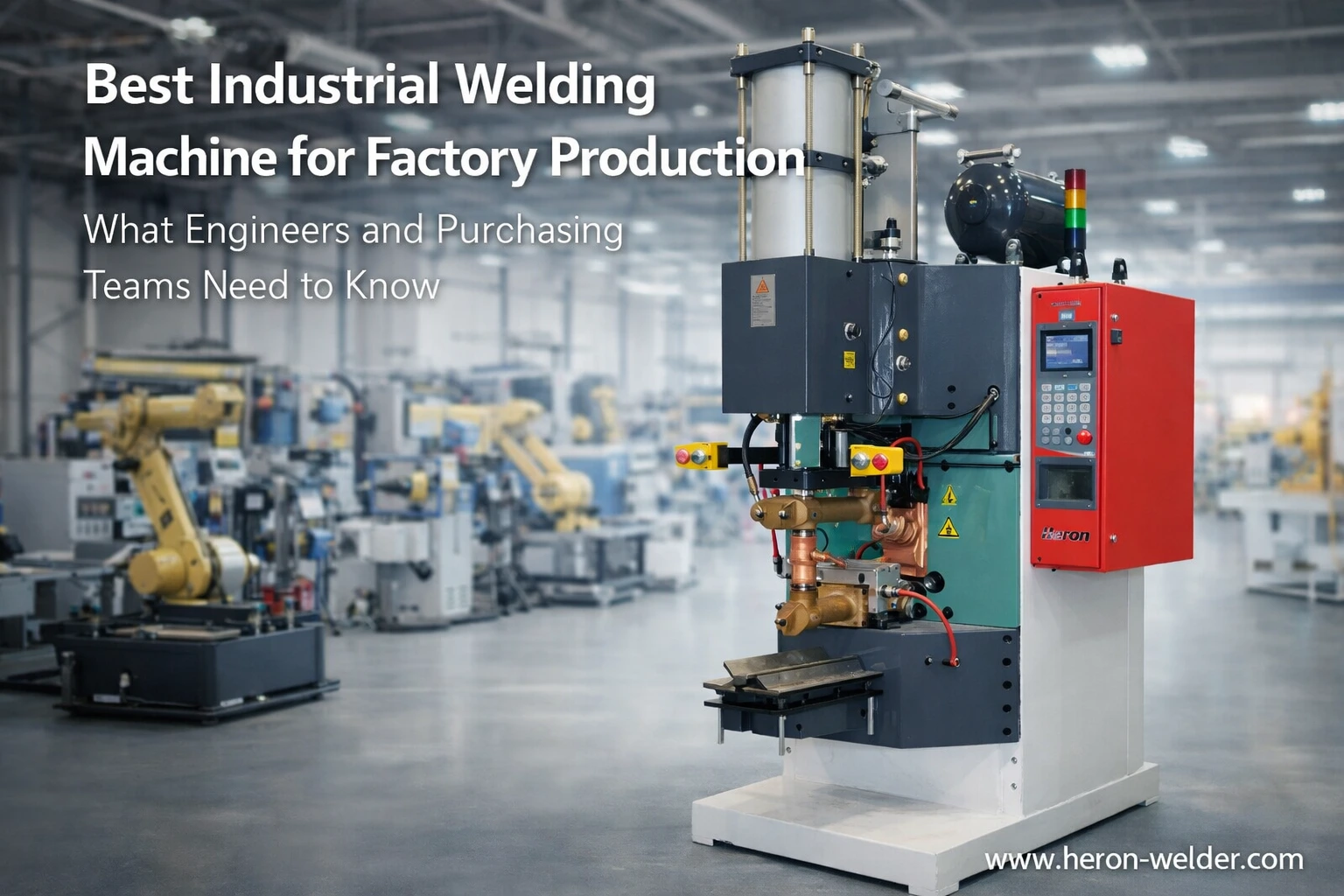
In today’s industrial landscape, efficiency, precision, and reliability in metal-joining processes are more critical than ever. A stud welder is a specialized welding tool designed to join metal studs or fasteners to a workpiece quickly and accurately, offering manufacturers and OEMs an efficient alternative to traditional welding or mechanical fastening methods. Heron Welder, a global leader in industrial welding solutions, delivers advanced stud welding systems and automation options to optimize production lines across diverse industries.
What is a Stud Welder?
A stud welder is a welding device used to attach metal studs, pins, or fasteners to a base metal using a controlled arc or capacitor discharge. Unlike conventional welding, stud welding ensures minimal distortion, high strength, and excellent electrical conductivity at the joint. This makes it ideal for applications requiring repeated fastener installations, high-speed assembly, or clean aesthetic finishes.
Key Components of a Stud Welder:
-
Welding gun or hand tool
-
Control unit for current, voltage, and timing
-
Power source (AC, DC, MFDC, or capacitor discharge)
-
Workpiece or metal base
By precisely controlling the welding parameters, a stud welder creates consistent joints that meet demanding industrial specifications.
How Stud Welding Works
Stud welding works on the principle of fusing a stud to a metal surface using concentrated heat. The process can be broadly categorized into two main types:
1. Arc Stud Welding
Arc stud welding uses a controlled electric arc to melt the base of the stud and a portion of the workpiece. The stud is then pressed into the molten pool, forming a strong metallurgical bond as it solidifies. This method is suitable for:
-
Thick or heavy-duty metal sheets
-
Structural components in construction or shipbuilding
-
Industrial enclosures and electrical panels
2. Capacitor Discharge (CD) Stud Welding
Capacitor discharge stud welding uses a high-voltage discharge to weld studs to thin or delicate metals, such as aluminum or stainless steel. The rapid welding time reduces heat distortion, making CD stud welding ideal for:
-
Automotive body panels
-
Electronic enclosures
-
Lightweight metal assemblies
Heron Welder provides both arc and capacitor discharge stud welding machines to meet varied industrial needs, including automated and semi-automated solutions for high-volume production.
Applications of Stud Welders in Industry
Stud welding is widely used across multiple sectors due to its speed, reliability, and ability to create strong joints without additional fasteners. Some common applications include:
-
Automotive Manufacturing: Attaching brackets, clips, and nuts to vehicle bodies with minimal distortion.
-
Construction & Architecture: Installing steel studs, rebar connectors, and anchor points for structural projects.
-
Electrical & Electronics: Securing terminals, busbars, and grounding studs in panels and enclosures.
-
Shipbuilding & Heavy Machinery: Fastening components to thick metal surfaces with durable welds.
-
Automation & Production Lines: High-speed stud welding stations integrated with robotic arms for repeatable, accurate results.
Heron Welder supports all these applications with customized solutions tailored to your production environment, ensuring both precision and throughput.
Advantages of Using a Stud Welder
Manufacturing engineers and production managers choose stud welding for several reasons:
-
High Efficiency: Rapid welding speeds reduce assembly time and labor costs.
-
Strong Joints: Metallurgical fusion provides high tensile and shear strength.
-
Minimal Distortion: Concentrated heat reduces warping or damage to surrounding areas.
-
Clean Finish: No need for secondary operations like grinding or finishing.
-
Automation-Friendly: Easily integrated with robotic or automated production lines.
By implementing Heron’s stud welding systems, factories can streamline assembly processes while maintaining quality standards.
Stud Welder vs. Traditional Welding
| Feature | Stud Welding | Conventional Welding |
|---|---|---|
| Welding Speed | High – seconds per stud | Slower – minutes per joint |
| Heat Affected Zone | Minimal | Larger, more distortion |
| Automation | Easily automated | More complex automation required |
| Joint Strength | High, localized | High but may need reinforcement |
| Surface Finish | Clean | May require grinding or finishing |
Heron’s range of stud welders, including MFDC and capacitor discharge models, ensures optimal performance for both thick and thin materials, outperforming traditional welding in many high-volume applications.
Best Practices for Stud Welding
To maximize the benefits of stud welding, manufacturers should follow these guidelines:
-
Material Preparation: Ensure clean, oxide-free surfaces to achieve consistent welds.
-
Correct Parameter Selection: Adjust current, voltage, and welding time based on stud size and material type.
-
Proper Tooling: Use the right stud welding gun and ferrule for each application.
-
Consistent Alignment: Maintain perpendicular contact between stud and base material.
-
Routine Maintenance: Keep welding guns, ferrules, and control units in top condition for reliable performance.
Heron Welder provides comprehensive support, training, and maintenance services to help manufacturers implement these best practices.
Frequently Asked Questions (FAQs)
1. Can a stud welder be used on aluminum?
Yes. Capacitor discharge stud welders are ideal for thin aluminum sheets, ensuring minimal heat distortion and strong joints.
2. What sizes of studs can be welded?
Stud welders can handle a wide range of diameters, typically from M3 to M16, depending on the model and welding method.
3. Can stud welding be automated?
Absolutely. Heron Welder’s systems can be integrated with robotic arms and automated production lines for high-volume, precise stud welding.
4. Is stud welding suitable for outdoor applications?
Yes. Stud welds provide strong, corrosion-resistant joints suitable for construction, shipbuilding, and infrastructure projects.
5. How does stud welding compare to mechanical fastening?
Stud welding provides stronger, more durable joints, faster installation, and cleaner finishes without additional hardware.
Why Choose Heron Welder for Stud Welding Solutions?
Heron Welder is a trusted partner for manufacturers worldwide, offering:
-
Advanced resistance and capacitor discharge stud welding machines
-
Automation-ready solutions for robotic and production line integration
-
Technical expertise in industrial welding and metal-joining applications
-
Customized solutions for OEMs, fabrication shops, and large-scale manufacturers
By choosing Heron, your production line benefits from precision, speed, and reliability, backed by a team of experts dedicated to optimizing metal-joining operations.
Ready to Upgrade Your Welding Process?
Discover how Heron’s stud welding systems can enhance efficiency, reduce labor costs, and ensure high-quality joints for your production. Request a quote or consult our team to design a custom welding and automation solution tailored to your manufacturing needs.

 English
 Arabic
 French
 Spanish
 Portuguese
 Deutsch
 Turkish
 Dutch
Dutch
 Italiano
 Russian
 Portuguese (Brazil)
 Tiếng Việt