


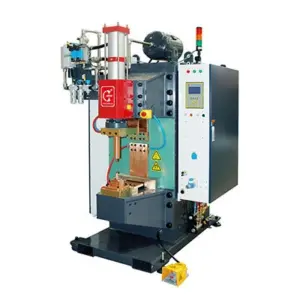
In today’s competitive manufacturing landscape, joining technologies must deliver reliable quality, high throughput, and seamless integration into automated production lines. Among the most widely used techniques for sheet metal assembly, resistance spot welding (RSW) stands out for its speed, repeatability, and cost‑effectiveness especially in high‑volume industries such as automotive, appliance, electronics, and structural metal fabrication.
As a global manufacturer of industrial welding and metal‑joining equipment, Heron Welder understands the critical role that precision spot welding plays in modern production. This guide breaks down the principles, applications, system comparisons, and best practices helping engineers and decision‑makers optimize their welding processes and select the right solutions for their needs.
What Is Resistance Spot Welding?
Resistance spot welding is a solid‑state welding process that joins two or more overlapping metal sheets by applying heat generated from electrical resistance at the interface. Heat is concentrated at the contact point, melting the material locally and forming a metallurgical bond known as a weld nugget.
The process involves three key elements:
-
Pressure — Applied by copper alloy electrodes to clamp the metal sheets securely.
-
Current — A high‑magnitude electrical pulse (typically 5–100 kA) passes through the contact interface.
-
Time — Precisely controlled duration of current application to achieve correct nugget formation.
Because of its reliance on electrical resistance rather than filler materials or external heat sources, spot welding is especially effective for thin to medium‑gauge conductive metals such as steel, stainless steel, and aluminum.
How Resistance Spot Welding Works: The Technical Breakdown
At its core, resistance spot welding follows a simple yet precise sequence:
-
Electrode Positioning and Clamping
Two copper alloy electrodes press the overlapping metal sheets together. The clamping force ensures sufficient contact and limits expulsion of molten material during welding. -
Current Flow and Heat Generation
A controlled electrical pulse flows through the electrodes, sheet stack, and back to the power source. The resistance at the sheet interface generates intense localized heat. -
Nugget Formation
Once the metal at the interface melts and re‑solidifies under pressure, a weld nugget forms. This nugget provides the structural joint. -
Cooling and Release
After the current stops, the weld cools under continued pressure. The electrodes then retract, and the welded assembly moves down the line.
Modern resistance spot welding systems utilize precise MFDC (Medium Frequency DC) power supplies, digital controllers, and real‑time monitoring to ensure weld quality and repeatability at high cycle rates.
Key Industrial Applications
Resistance spot welding is a cornerstone process across multiple sectors:
Automotive Manufacturing
In automotive body‑in‑white (BIW) production, hundreds to thousands of spot welds are required to join panels, reinforcements, and subassemblies. The process’s speed and reliability make it ideal for robotic automation in high‑volume lines.
Consumer Appliances
Appliance housings, frames, and internal components often rely on spot welding due to fast cycle times and minimal post‑processing.
Electronics and Battery Packs
Compact assemblies and battery module fabrication benefit from precise control and low thermal distortion both strengths of modern spot welding systems.
Structural Fabrication
Light‑to‑medium structural assemblies in HVAC, furniture, and architectural metalwork use resistance spot welding to produce clean, strong joints with minimal finish work.
Resistance Spot Welding vs. Other Joining Methods
Understanding how resistance spot welding compares with alternative techniques helps manufacturers choose the optimal process:
RSW vs. MIG/TIG Welding
| Feature | Resistance Spot Welding | MIG/TIG Welding |
|---|---|---|
| Speed | Very high | Moderate to slow |
| Automation | Highly automatable | Automatable but more complex |
| Heat Input | Localized | Larger heat‑affected zone |
| Filler Material | Not required | Usually required |
| Operator Skill | Lower (robotic) | Higher (manual) |
Resistance spot welding excels in high‑volume, thin‑gauge applications where speed and automation trump flexibility. MIG and TIG remain better for thicker materials, non‑ferrous alloys, and precision joints requiring filler.
RSW vs. Adhesive Bonding
Spot welding provides immediate, load‑bearing joints without curing time or surface prep requirements associated with adhesives. However, adhesives can complement spot welds in multimaterial assemblies or when surface appearance is critical.
Best Practices for Optimal Spot Welding Performance
Achieving consistent spot weld quality is less about brute electrical power and more about controlling key process variables:
1. Electrode Selection and Maintenance
Copper‑chrome and copper‑tungsten alloys are common for electrodes due to high conductivity and wear resistance. Regular dressing (reshaping) ensures proper contact geometry and reduces weld variability.
2. Proper Clamping Force
Too little force increases resistance and may lead to expulsion (splash), while too much force reduces resistance and diminishes nugget size. Digital force control ensures repeatability.
3. Sheet Fit‑up and Surface Condition
Gaps, coatings, rust, or oil can affect heat generation and weld quality. Good fit‑up and pre‑process cleaning reduce variability.
4. Process Monitoring and Controls
Real‑time measurement of current, force, and dynamic resistance helps detect weld anomalies and maintain consistent nugget formation critical in automated production.
5. Cooling Management
Water‑cooled electrodes and fixture cooling prevent overheating and extend component life, especially in high‑duty cycle applications.
Heron’s Spot Welding Solutions: Precision, Power, and Performance
At Heron Welder, we design and manufacture a comprehensive range of resistance spot welding machines, power supplies, controllers, and automation systems tailored to industrial needs:
-
MFDC Spot Welders for energy‑efficient, high‑repeatability welding
-
Capacitor Discharge Spot Systems for thin gages and controlled heat input
-
Robotic Integration Platforms for automotive and high‑volume fabricators
-
Advanced Weld Control Software for data logging and quality traceability
Our global service network supports installation, training, and process optimization helping manufacturers reduce cycle times, improve joint quality, and increase throughput.
Frequently Asked Questions (FAQs)
What is the ideal material thickness for resistance spot welding?
Resistance spot welding is most effective for sheet metals ranging from 0.5 mm to 6 mm per sheet. Material conductivity and stack‑up influence current requirements and cycle times.
Can aluminum be resistance spot welded?
Yes, aluminum alloys can be spot welded, but they require higher currents and precise control due to higher thermal conductivity. MFDC systems and optimized electrodes improve weld consistency.
How do I know if a spot weld is good?
Good welds are characterized by a symmetrical nugget size (typically ≥5√t where t is sheet thickness) and proper indentation. Non‑destructive testing and dynamic resistance monitoring help ensure quality.
What are common causes of weld expulsion?
Excessive current, too high electrode force, or improper timing can lead to molten metal expulsion. Balancing electrical and mechanical parameters is critical.
Can spot welding be automated?
Absolutely — spot welding is one of the most widely automated joining processes. Robotic arms, servo controls, and integrated sensors deliver high throughput and repeatability.
Conclusion: Optimize Your Spot Welding with Heron
Resistance spot welding remains a foundation of efficient, high‑speed metal joining for industries demanding consistent results and seamless automation. Whether you’re building automotive structures, appliances, or advanced battery systems, choosing the right equipment and process controls makes all the difference.
Ready to enhance your welding operations?
Contact Heron Welder for a customized solution from MFDC spot welding units to fully automated production lines. Request a quote or speak with our applications experts today to optimize your resistance welding process and achieve superior manufacturing results.

 English
 Arabic
 French
 Spanish
 Portuguese
 Deutsch
 Turkish
 Dutch
Dutch
 Italiano
 Russian
 Romaian
 Portuguese (Brazil)