


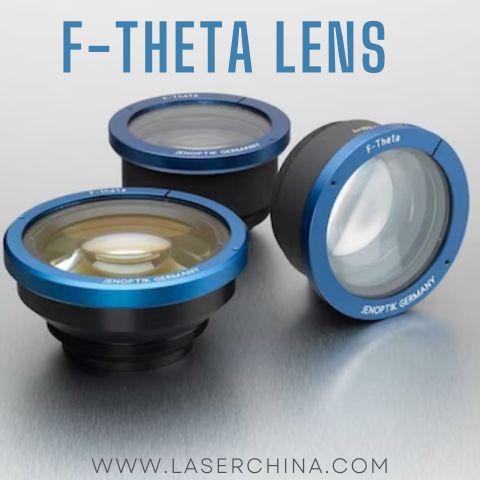
The F-theta lens is a specialized optical component designed to provide precise laser focusing across a flat field, making it a cornerstone in modern laser applications. Widely used in industrial, medical, and scientific fields, the F-theta lens allows laser systems to maintain consistent performance while scanning across a wide surface area. These lenses are engineered to deliver predictable laser spot positions, ensuring that every point on the target plane receives accurate energy distribution.
Industrial laser systems rely heavily on F-theta lenses to achieve high-speed scanning without sacrificing accuracy. In laser marking, engraving, and cutting processes, the flat-field focus provided by these lenses ensures that the laser maintains uniform precision across the entire working surface. Unlike conventional lenses that produce curved fields and inconsistent focal lengths, F-theta lenses correct for field curvature, allowing the laser beam to remain in focus over large areas. This characteristic is essential for applications that demand high precision over repetitive tasks.
F-theta lenses are compatible with a variety of laser sources, including fiber lasers, CO₂ lasers, and diode-pumped solid-state lasers. Their versatility makes them suitable for multiple industries, from electronics and automotive to medical device manufacturing. In electronics, for instance, F-theta lenses are instrumental in PCB laser drilling and cutting, where micron-level precision is required. Similarly, in the automotive industry, these lenses enable accurate laser welding, engraving, and surface treatment, contributing to superior product quality and consistency.
The design of F-theta lenses focuses on translating the angular motion of a scanning mirror into linear motion on the work surface. This allows laser scanners to move the beam quickly and accurately without distortion. Such precision is vital for complex patterns, intricate engravings, or high-speed manufacturing processes where even minor deviations can lead to defective products or wasted material. The ability to deliver a flat-field scan also makes F-theta lenses ideal for applications requiring uniform intensity distribution, such as laser sintering in additive manufacturing or laser lithography in semiconductor production.
In medical applications, F-theta lenses play a key role in laser surgery, dermatology, and ophthalmology. Surgical lasers rely on the exact placement of energy to perform delicate procedures, and the precision provided by F-theta lenses ensures minimal impact on surrounding tissues. Similarly, in dermatology, lasers equipped with these lenses deliver consistent treatment across the skin surface, optimizing results while enhancing patient safety. Ophthalmology benefits from F-theta lenses in procedures like LASIK, where precise energy delivery is crucial for reshaping corneal tissue accurately.
Scientific research also benefits from the capabilities of F-theta lenses. They are used in high-precision laser experiments, spectroscopy, and optical measurement systems. The flat-field focus allows researchers to conduct experiments with consistent laser positioning, reducing errors and increasing reproducibility. In photonics laboratories, F-theta lenses are critical for beam shaping, alignment, and scanning applications, enabling scientists to push the boundaries of optical innovation.
Manufacturers of F-theta lenses employ advanced materials and coatings to optimize performance. High-quality glass and specialized coatings improve transmission efficiency, reduce reflections, and enhance durability under high-power laser operation. These factors contribute to reliable long-term operation, which is particularly important in industrial environments where equipment uptime directly impacts productivity. Additionally, modern F-theta lenses are designed to withstand high thermal loads, ensuring stability and performance even during continuous high-power laser operation.
Customization is another significant aspect of F-theta lenses. Depending on the application, lenses can be tailored for specific wavelengths, focal lengths, and working distances. This flexibility allows laser systems to be optimized for particular tasks, whether it is ultra-fine engraving, high-speed cutting, or delicate medical procedures. By choosing the right combination of lens parameters, operators can achieve maximum efficiency, precision, and consistency across their laser processes.
Integration of F-theta lenses into laser scanning systems also enhances workflow efficiency. With precise focusing and accurate beam positioning, production cycles can be faster, and the need for manual adjustments or rework is minimized. In industries where high-volume production is critical, this level of precision translates directly into cost savings and improved product quality. The adaptability of F-theta lenses ensures that they can meet evolving industry standards and technological advancements, keeping laser systems competitive and future-ready.
F-theta lenses continue to evolve with technological progress in laser systems. Innovations in lens materials, coatings, and design methodologies are expanding the capabilities of these lenses, enabling them to handle higher power densities and larger scan areas. Researchers and engineers are constantly exploring ways to enhance the optical performance, durability, and versatility of F-theta lenses, allowing laser applications to reach new levels of precision and productivity.
From industrial manufacturing to healthcare and scientific research, F-theta lenses have become indispensable components in laser technology. Their ability to maintain a flat-field focus, deliver precise laser placement, and withstand demanding operational conditions ensures that they remain at the forefront of optical innovation. With ongoing advancements, the potential applications for F-theta lenses continue to grow, making them a critical element in achieving excellence across a broad range of laser-based technologies.
The combination of precision engineering, advanced optical materials, and versatile design makes F-theta lenses a vital investment for any organization relying on laser technology. Whether for high-speed production, intricate laser engraving, delicate medical procedures, or advanced scientific research, these lenses provide consistent, reliable, and high-quality performance that meets the demands of modern laser systems.
By understanding the role and capabilities of F-theta lens, operators and engineers can fully leverage their potential to enhance laser performance, improve process accuracy, and maintain consistent results. The continuous innovation in this field ensures that F-theta lenses will remain essential in both current and future laser applications.

 English
 Arabic
 French
 Spanish
 Portuguese
 Deutsch
 Turkish
 Italiano
 Russian
 Romaian
 Portuguese (Brazil)
 Tiếng Việt