


The global push for hyper-automation and the critical need for businesses to unlock the value hidden in their unstructured data has created a massive and rapidly growing enterprise software market. The global Intelligent Document Processing Market is a thriving ecosystem of software vendors and service providers dedicated to building and deploying AI-powered solutions for data extraction. This market has evolved from traditional optical character recognition (OCR) and data capture tools into sophisticated platforms that can handle a wide variety of complex and variable documents. Driven by the pressures of digital transformation, the need to reduce manual labor costs, and the desire to accelerate business processes, organizations across all sectors are aggressively adopting IDP. This strategic shift is creating a multi-billion dollar market where vendors compete on the accuracy of their AI models, their ease of use, and the breadth of their pre-trained solutions.
To better understand its structure, the market can be segmented by its core components, deployment models, and the specific business processes it serves. By component, the market is divided into the IDP software/platform itself and the associated professional services, which include solution design, implementation, model training, and integration. By deployment, solutions are offered as on-premise software, which is often preferred by organizations with very strict data security requirements, or, more commonly, as a cloud-based Software-as-a-Service (SaaS) platform, which offers greater scalability and a lower barrier to entry. The market is also segmented by use case, with major applications in accounts payable automation (processing invoices), customer onboarding (processing ID documents and application forms), claims processing in insurance, and logistics document processing (bills of lading, etc.).
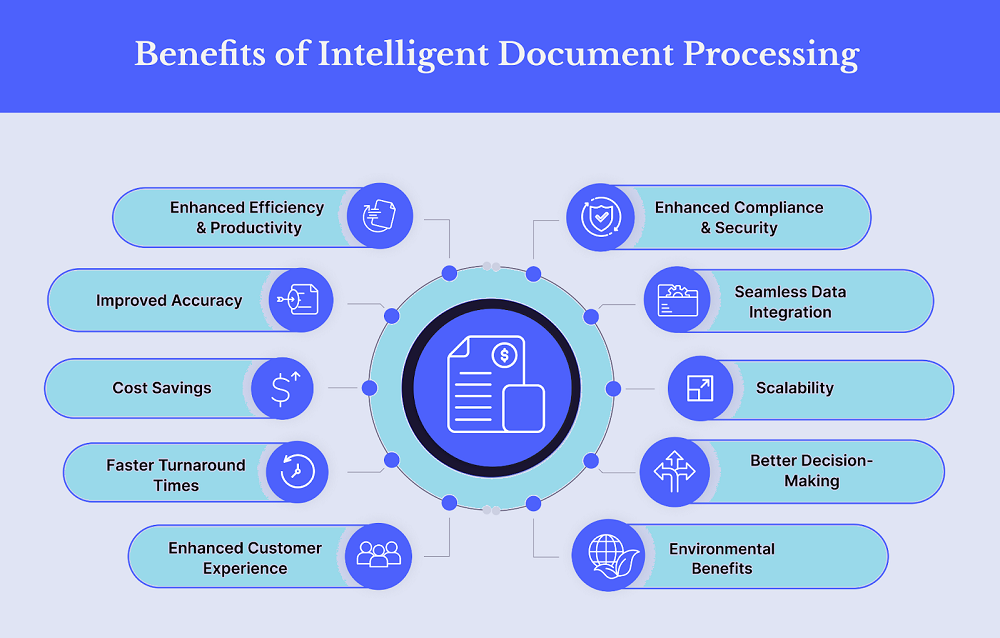
The primary forces propelling the market's explosive expansion are powerful and clear. The number one driver is the immense operational efficiency and cost savings that IDP delivers. By automating the manual, time-consuming, and error-prone task of data entry, organizations can reduce their processing costs by up to 80% and can reallocate their human employees to higher-value, customer-facing, or analytical work. The need for speed and improved customer experience is another major catalyst. For example, by using IDP to instantly process a loan application or an insurance claim, a business can provide a much faster decision to its customers, which is a major competitive advantage. Furthermore, the advancements in AI and machine learning have made IDP technology more accurate and easier to use than ever before, lowering the barrier to adoption for a wider range of businesses.
Despite the strong growth prospects and clear ROI, the IDP market is not without its challenges. The primary hurdle for any IDP project is the variability and quality of the documents themselves. Scanned documents can be of poor quality, and even within a single document type like an invoice, the layout and format can vary dramatically from one vendor to another. While modern IDP is much better at handling this than older technologies, it still requires robust AI models and often a "human-in-the-loop" process for handling exceptions. The initial effort required to train the AI models on a company's specific document types can also be a significant undertaking. Data privacy and security are also key concerns, as these systems often process highly sensitive financial and personal information, requiring a secure and compliant platform.
Other Exclusive Reports:
Optical Transport Network Market

 English
 Arabic
 Spanish
 Portuguese
 Deutsch
 Turkish
 Dutch
Dutch
 Italiano
 Russian
 Romaian
 Portuguese (Brazil)
 Tiếng Việt